
Java ArrayList vs LinkedList: Performance and When to Use
Introduction
ArrayList and LinkedList both implement List, so a program can use either one with the same method calls - and get very different speed and memory use. This tutorial compares the two. It covers, in this order, how each class stores its elements, what each list operation costs as a result, a timing program that measures eight operations on both lists, the memory each list needs per element, why ArrayDeque is the better choice for a queue, and a short guide for choosing between them. The examples run on JDK 25.(Note - This tutorial builds on Java Collections Framework: Overview and HierarchyClick to read tutorial: Java Collections Framework: Overview and Hierarchy, which introduces the
List interface.)
How ArrayList stores its elements
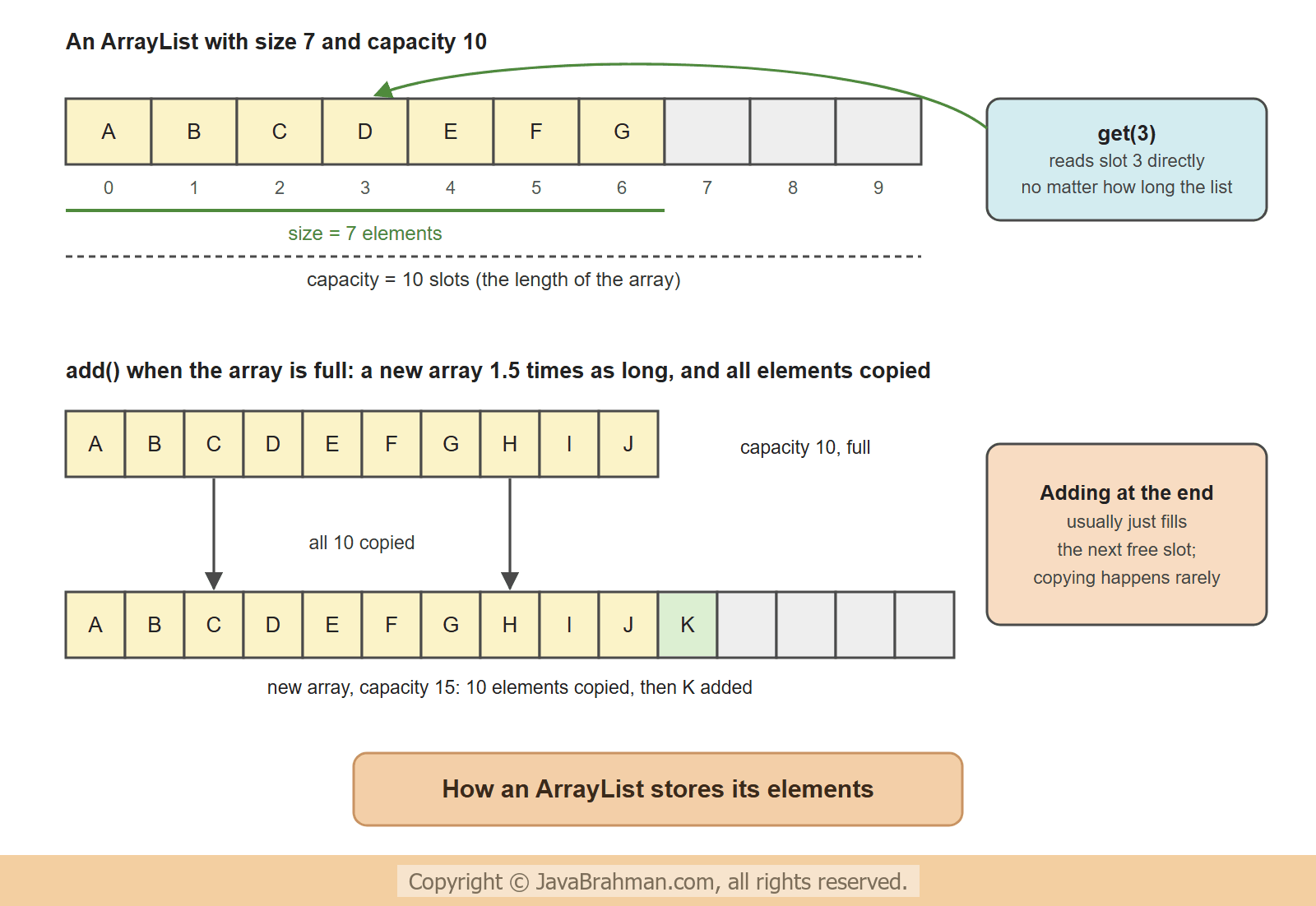
AnArrayList keeps its elements in an ordinary array, plus a count of how many slots of it are used. Two numbers therefore describe it: its size, the number of elements, and its capacity, the length of the array behind it.
- Element
iis in sloti, soget(i)andset(i, e)go straight to it, however long the list is. add(e)puts the element into the next free slot. When the array is full, the list creates a new array about one and a half times as long, copies all elements into it, and continues there. This happens rarely, so adding at the end is still fast on average.- Adding or removing anywhere else shifts every element after that position by one slot, to open or close the gap.
--add-opens java.base/java.util=ALL-UNNAMED a program can look at it through reflection. This one adds 50 elements and prints the capacity each time it changes:
ArrayListGrowth.java
//ArrayListGrowth.java
import java.lang.reflect.Field;
import java.util.ArrayList;

public class ArrayListGrowth {
  public static void main(String[] args) throws Exception {
    Field elementData = ArrayList.class.getDeclaredField("elementData");
    elementData.setAccessible(true);   // needs --add-opens java.base/java.util=ALL-UNNAMED

    ArrayList<Integer> list = new ArrayList<>();
    int capacity = ((Object[]) elementData.get(list)).length;
    System.out.println("empty list: size 0, capacity " + capacity);
    for (int i = 1; i <= 50; i++) {
      list.add(i);
      int now = ((Object[]) elementData.get(list)).length;
      if (now != capacity) {
        System.out.println("adding element " + i + ": capacity " + capacity + " -> " + now);
        capacity = now;
      }
    }
    System.out.println("size " + list.size() + ", capacity " + capacity);
    list.trimToSize();
    System.out.println("after trimToSize(): capacity " + ((Object[]) elementData.get(list)).length);
  }
}empty list: size 0, capacity 0 adding element 1: capacity 0 -> 10 adding element 11: capacity 10 -> 15 adding element 16: capacity 15 -> 22 adding element 23: capacity 22 -> 33 adding element 34: capacity 33 -> 49 adding element 50: capacity 49 -> 73 size 50, capacity 73 after trimToSize(): capacity 50
ArrayList starts without an array; the first add() creates one of 10 slots, and each later growth adds half of the current capacity: 10, 15, 22, 33, 49, 73. trimToSize() shrinks the array to the size. When the final size is known in advance, new ArrayList<>(1000) creates the right capacity at once and avoids the copying.
How LinkedList stores its elements
ALinkedList is a doubly linked list. Each element is wrapped in a small node object that also holds a reference to the previous node and to the next one; the list itself only knows its first and its last node.
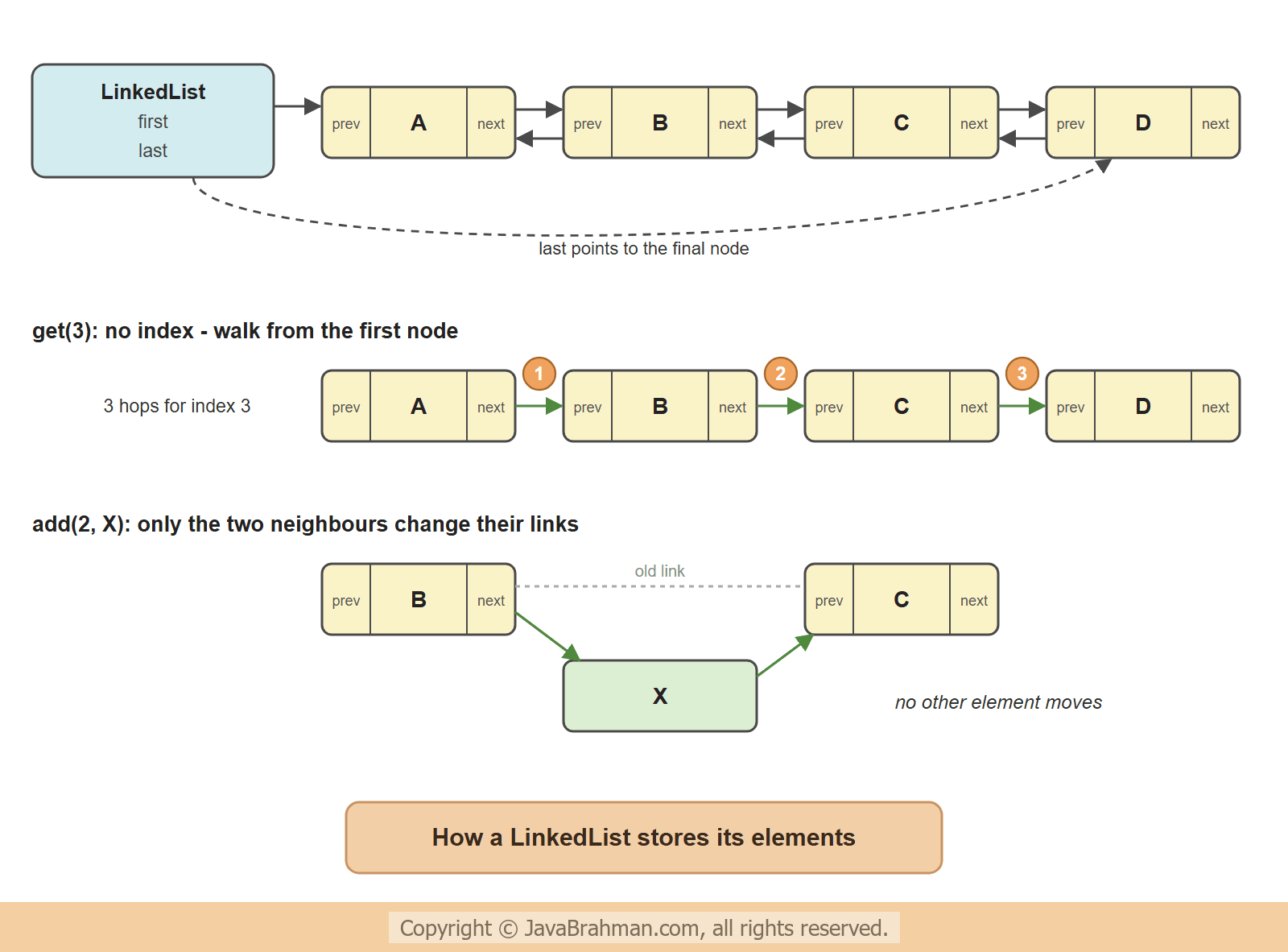
- Adding or removing an element only changes the references of its neighbours; no other element moves. At the two ends this is immediate, because the list knows the first and the last node.
- There is no index: to reach element
i, the list follows the links from the nearer end, one node at a time.get(i),set(i, e), andadd(i, e)orremove(i)in the middle all have to walk there first. - Every element costs a separate node object, and the nodes are scattered in memory.
What each operation costs
From the two ways of storing, the cost of each operation follows. O(1) means the time does not depend on the size of the list, O(n) that it grows in proportion to it.| Operation | ArrayList | LinkedList |
|---|---|---|
get(i), set(i, e) | O(1) | O(n) - walks to position i |
add(e) at the end | O(1) on average (the array sometimes grows) | O(1) |
add(0, e), remove(0) at the front | O(n) - shifts all elements | O(1) |
add(i, e), remove(i) in the middle | O(n) - shifts the elements after i | O(n) - walks to i, then O(1) to link |
insert or remove through a ListIterator that is already there | O(n) - shifts the elements after it | O(1) |
| iterating over all elements | O(n), very fast - adjacent memory | O(n), slower - node to node |
| memory per element | one reference, plus unused capacity | a node object with three references |
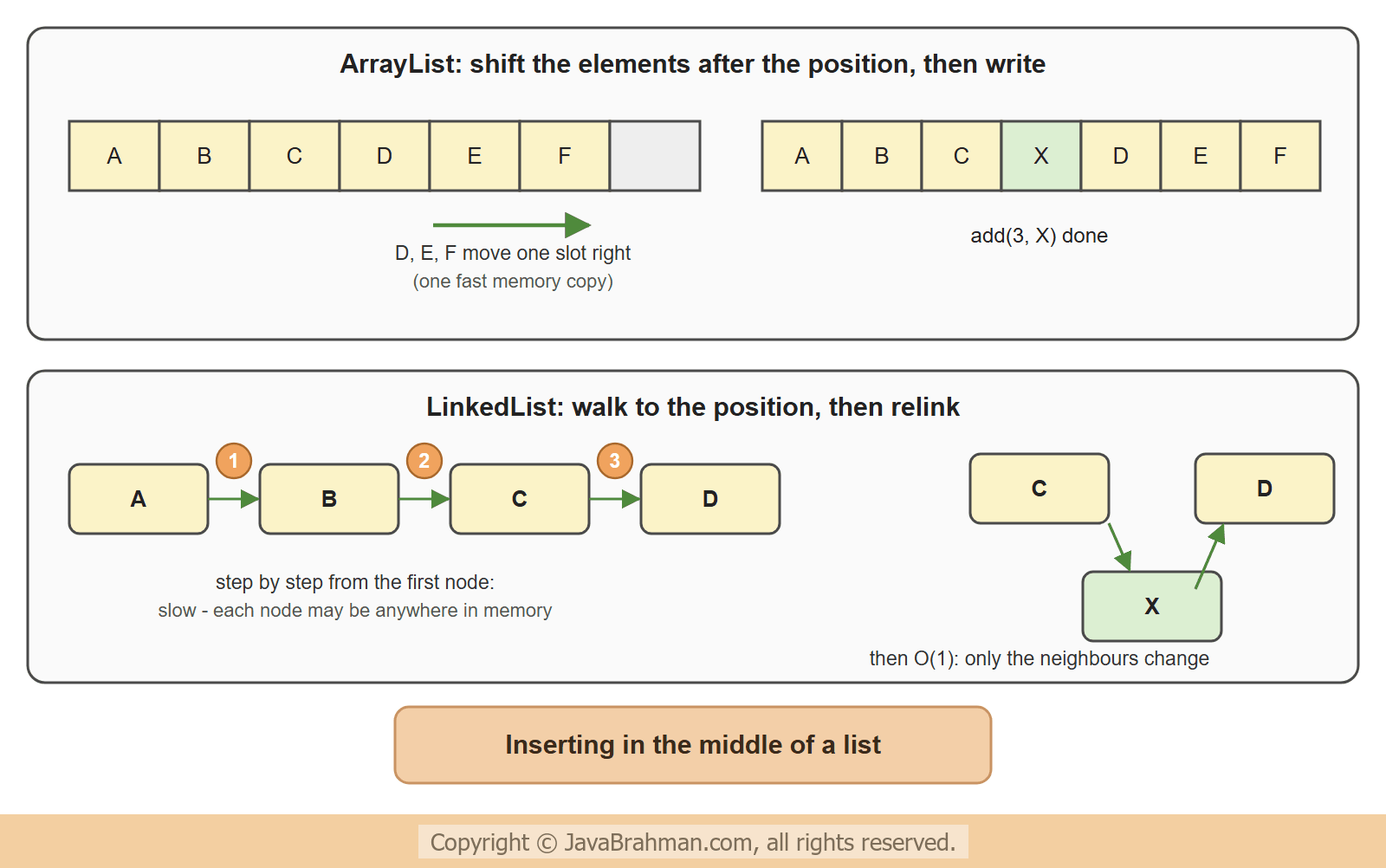
LinkedList can link a new node in O(1), but only after walking to the position, which is O(n) as well - and walking from node to node is slower than shifting an array, which the processor does in one fast memory copy.
Measuring the difference
The following program times eight operations on both lists, each on a fresh list of 100,000 elements. Every measurement is repeated seven times, and the median is printed; the code runs a few rounds first, so that the JIT compiler has compiled it before the measuring starts.ListTimings.java
//ListTimings.java
import java.util.ArrayList;
import java.util.Arrays;
import java.util.LinkedList;
import java.util.List;
import java.util.ListIterator;
import java.util.Random;
import java.util.function.Supplier;

public class ListTimings {

  static final int SIZE = 100_000;
  static final int OPS = 10_000;
  static long sink;   // results are added here so that the JIT compiler cannot skip the work

  interface Task { void run(List<Integer> list); }

  static List<Integer> filled(Supplier<List<Integer>> factory) {
    List<Integer> list = factory.get();
    for (int i = 0; i < SIZE; i++) list.add(i);
    return list;
  }

  // runs the task on a fresh list 7 times and returns the median time in milliseconds
  static double time(Supplier<List<Integer>> factory, Task task, boolean prefill) {
    double[] ms = new double[7];
    for (int r = 0; r < ms.length; r++) {
      List<Integer> list = prefill ? filled(factory) : factory.get();
      long start = System.nanoTime();
      task.run(list);
      ms[r] = (System.nanoTime() - start) / 1e6;
      sink += list.size();
    }
    Arrays.sort(ms);
    return ms[ms.length / 2];
  }

  static void row(String name, Task task, boolean prefill) {
    double a = time(ArrayList::new, task, prefill);
    double l = time(LinkedList::new, task, prefill);
    System.out.printf("%-34s %10.2f %11.2f%n", name, a, l);
  }

  public static void main(String[] args) {
    int[] indexes = new Random(42).ints(OPS, 0, SIZE).toArray();
    Task addAtEnd = list -> { for (int i = 0; i < SIZE; i++) list.add(i); };
    Task getByIndex = list -> { for (int i : indexes) sink += list.get(i); };
    Task iterate = list -> { for (int v : list) sink += v; };
    Task addAtFront = list -> { for (int i = 0; i < OPS; i++) list.add(0, i); };
    Task removeAtFront = list -> { for (int i = 0; i < OPS; i++) list.remove(0); };
    Task addInMiddle = list -> { for (int i = 0; i < OPS; i++) list.add(list.size() / 2, i); };
    Task iteratorInsert = list -> {   // inserts -1 after every tenth element
      ListIterator<Integer> it = list.listIterator();
      while (it.hasNext()) { if (it.next() % 10 == 0) it.add(-1); }
    };
    Task removeIfHalf = list -> list.removeIf(v -> v % 2 == 0);

    for (int warmUp = 0; warmUp < 2; warmUp++) {
      time(ArrayList::new, getByIndex, true);
      time(LinkedList::new, iterate, true);
      time(ArrayList::new, addInMiddle, true);
      time(LinkedList::new, addAtFront, true);
    }

    System.out.printf("%-34s %10s %11s%n", "operation (100,000 elements)", "ArrayList", "LinkedList");
    row("add 100,000 at the end", addAtEnd, false);
    row("get(i) at 10,000 random indexes", getByIndex, true);
    row("iterate over all elements", iterate, true);
    row("add(0, e) 10,000 times", addAtFront, true);
    row("remove(0) 10,000 times", removeAtFront, true);
    row("add(size/2, e) 10,000 times", addInMiddle, true);
    row("insert with ListIterator.add()", iteratorInsert, true);
    row("removeIf() on half the elements", removeIfHalf, true);
    System.out.println("(milliseconds, median of 7 runs)");
  }
}operation (100,000 elements) ArrayList LinkedList add 100,000 at the end 2.58 3.26 get(i) at 10,000 random indexes 0.11 331.40 iterate over all elements 1.05 3.64 add(0, e) 10,000 times 97.51 0.18 remove(0) 10,000 times 70.62 0.82 add(size/2, e) 10,000 times 46.77 684.03 insert with ListIterator.add() 45.93 4.64 removeIf() on half the elements 2.49 1.97 (milliseconds, median of 7 runs)
- Access by index is where
LinkedListloses badly: 10,000 calls ofget(i)took a fraction of a millisecond on theArrayListand hundreds of milliseconds on theLinkedList, which walked on average 25,000 nodes per call. A loop such asfor (int i = 0; i < list.size(); i++) list.get(i)over aLinkedListis the classic way to make a program slow; a for-each loop does not have this problem. - Adding at the end took about the same time on both, and iterating was faster on the
ArrayList, whose elements lie next to each other in memory. - At the front,
LinkedListwins:add(0, e)andremove(0)cost it almost nothing, while theArrayListshifted up to 110,000 elements each time. - In the middle by index,
ArrayListwins - more than ten times faster here, although it shifted 50,000 elements per insert. TheLinkedListspent its time walking to the middle. - When the position is reached anyway during a pass over the list, as with
ListIterator.add(), theLinkedListonly relinks and was about ten times faster.removeIf()was close on both lists - in some runs theLinkedListwas ahead - becauseArrayList.removeIf()moves the remaining elements in a single pass, not once per removed element.
Memory per element
Each element of aLinkedList needs a node object: an object header plus three references - the element, the previous node and the next node. An ArrayList needs one reference per element, plus the unused part of its array. The next program fills each list with one million references to the same object, so that only the memory of the list itself is measured.
ListMemory.java
//ListMemory.java
import java.util.ArrayList;
import java.util.LinkedList;
import java.util.List;
import java.util.function.Supplier;

public class ListMemory {

  static final int SIZE = 1_000_000;

  static long usedMemory() {
    for (int i = 0; i < 3; i++) System.gc();
    Runtime rt = Runtime.getRuntime();
    return rt.totalMemory() - rt.freeMemory();
  }

  static void measure(String name, Supplier<List<Object>> factory) {
    Object element = new Object();   // the same element every time, so only the list itself is measured
    long before = usedMemory();
    List<Object> list = factory.get();
    for (int i = 0; i < SIZE; i++) list.add(element);
    long after = usedMemory();
    System.out.printf("%-32s %5.1f MB  %5.1f bytes per element%n", name, (after - before) / 1e6, (after - before) / (double) SIZE);
    if (list.size() != SIZE) throw new AssertionError();
  }

  public static void main(String[] args) {
    measure("ArrayList, grown by add()", ArrayList::new);
    measure("ArrayList, new ArrayList<>(SIZE)", () -> new ArrayList<>(SIZE));
    measure("LinkedList", LinkedList::new);
  }
}ArrayList, grown by add() 5.2 MB 5.2 bytes per element ArrayList, new ArrayList<>(SIZE) 4.2 MB 4.2 bytes per element LinkedList 24.0 MB 24.0 bytes per element
- The
ArrayListcreated with its final capacity needed about 4 bytes per element - one reference, which the JVM stores in 4 bytes on a heap of this size. Grown byadd(), it needed more, because its last growth left part of the array unused. - The
LinkedListneeded about 24 bytes per element, around five times as much. On a list of millions of elements the difference is tens of megabytes, and more objects also mean more work for the garbage collector.
LinkedList as a queue - use ArrayDeque instead
LinkedList also implements Deque, and is often used as a queue or a stack because adding and removing at the ends is cheap. For that purpose the JDK has a class made for it: ArrayDeque, which stores the elements in a circular array, has the same O(1) operations at both ends without a node per element, and is described in its documentation as likely to be faster than LinkedList when used as a queue. Unlike LinkedList, it does not accept null elements.
When to use which
- Use
ArrayListby default. Most lists are filled at the end, read by index or iterated over, and that is whereArrayListis fast and compact. - Choose
LinkedListonly when the program mainly inserts or removes while iterating with aListIteratorover a long list, or at the front of a list that is not a queue - and measure, because the walking cost often cancels the gain. - For a queue, a stack or work at both ends, use
ArrayDeque. - Never read a
LinkedListby index in a loop; iterate with for-each or an iterator. - Because both implement
List, declare variables asList<E>: switching from one to the other is then a change of one line.
Summary
In this tutorial we saw that anArrayList stores its elements in an array that grows by half when it is full, and a LinkedList in nodes linked in both directions. From that, ArrayList reads any position at once but shifts elements to insert or remove, while LinkedList relinks without shifting but has to walk to a position first. A timing program measured eight operations: get(i) and inserts in the middle by index were far faster on the ArrayList, work at the front and inserts through a ListIterator were faster on the LinkedList. A memory measurement showed about 4 bytes per element for ArrayList against about 24 for LinkedList. ArrayList is the default choice, and ArrayDeque is the better queue.Java Collections Tutorials
Java Collections Framework: Overview and HierarchyClick to read tutorial: Java Collections Framework: Overview and Hierarchy Introduction to Java Generics: Why and HowClick to read tutorial: Introduction to Java Generics: Why and How Java 21 Sequenced Collections ExplainedClick to read tutorial: Java 21 Sequenced Collections Explained Understanding equals and hashCode contract when using collectionsClick to read tutorial: Understanding equals and hashCode contract when using collections Java 9 Immutable Collections: List.of, Set.of, Map.ofClick to read tutorial: Java 9 Immutable Collections: List.of, Set.of, Map.of Java Wrapper Classes Tutorial with ExamplesClick to read tutorial: Java Wrapper Classes Tutorial with Examples Java 8 Streams API Tutorial with ExamplesClick to read tutorial: Java 8 Streams API Tutorial with Examples
Java Collections Framework: Overview and HierarchyClick to read tutorial: Java Collections Framework: Overview and Hierarchy Introduction to Java Generics: Why and HowClick to read tutorial: Introduction to Java Generics: Why and How Java 21 Sequenced Collections ExplainedClick to read tutorial: Java 21 Sequenced Collections Explained Understanding equals and hashCode contract when using collectionsClick to read tutorial: Understanding equals and hashCode contract when using collections Java 9 Immutable Collections: List.of, Set.of, Map.ofClick to read tutorial: Java 9 Immutable Collections: List.of, Set.of, Map.of Java Wrapper Classes Tutorial with ExamplesClick to read tutorial: Java Wrapper Classes Tutorial with Examples Java 8 Streams API Tutorial with ExamplesClick to read tutorial: Java 8 Streams API Tutorial with Examples